14 September 2026 · HushOS
HushOS 1.0
Private storage for your files that does not feel like a chore. What we set out to do, what version 1 means, what we got wrong the first time, and where we are going next.
HushOS 1.0 is live today at hushos.com.
It is a drive. You keep your files in it and share them, the way you would with any drive. The difference is that every file is locked on your own device before it goes anywhere. Only you, and the people you choose, hold the keys. Not us. Not our hosting provider. Not anyone who breaks in.
This post covers four things: why privacy matters now, what we set out to build, how we got here, and what comes next.
Why privacy, and why now
Most of what matters to you lives in files. Medical letters. The lease. The photos. The half-finished plans. The spreadsheet with the numbers you would rather not share.
For twenty years the deal has been simple: hand those files to a company, get convenience back, and let the company read them. Not a person, usually. Systems. Systems that sort you into buckets, decide what to show you, and sell the shape of your life to whoever is buying.
Two things have made that deal worse.
- Scale. What used to be logs is now big data, kept forever because storage is cheap and someone might find a use for it later.
- Language models. Every large model you have heard of was trained on whatever its makers could reach. That includes a lot that people never thought of as public. A readable file on a server is now a file that can be learned from, summarised and searched by systems whose owners you did not choose.
You do not have to be hiding anything to mind this. You only have to want your own things to stay your own. That is what privacy means. Not secrecy. Ownership.
The trouble is that privacy tools have made this hard:
- Key files to keep safe.
- Settings to get right.
- A second app to install.
- A warning on every screen.
Most people look at that and, reasonably, go back to whatever was easy. And the easy thing reads their files.
What we set out to do
The goal of HushOS fits in one sentence: make the private choice the easy choice.
That means building something a person with no interest in technology would pick because it is pleasant to use. And keeping it private because that is how it is made, not because they found a setting.
- No setting to find.
- No key file to lose.
- An email, a password, and one recovery phrase written down once.
- After that, it is just your drive.
It also means being honest about the cost. Because we cannot read your files, we cannot recover them if you lose both your password and your phrase. We say that on the sign-up page, on the security page, and here. It is the one trade for real privacy, and we would rather you know it now than find out later.
- Your files
- Locked on your device before they leave it
- Your password
- Never sent to us, not even a scrambled version
- Your keys
- Made on your device, wrapped for the people you share with
- The code
- Open source, under the AGPL, for anyone to read or run
- The catch
- Lose your password and your recovery phrase, and nobody can help
What version 1 means
We do not use version numbers loosely. 1.0 means three things: the product is whole, people other than us have tested it, and we will not take features away from under you.
What you get in 1.0:
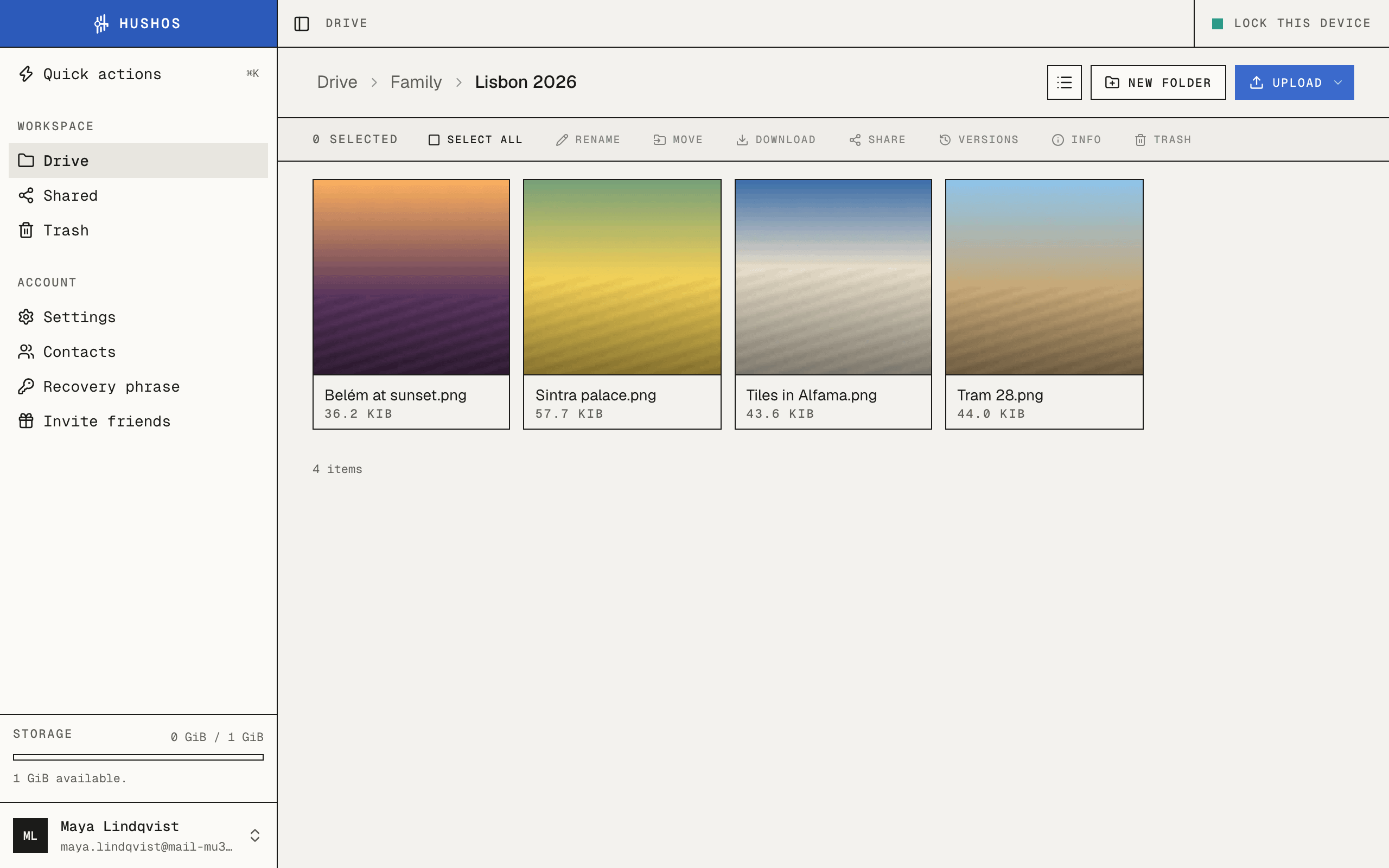
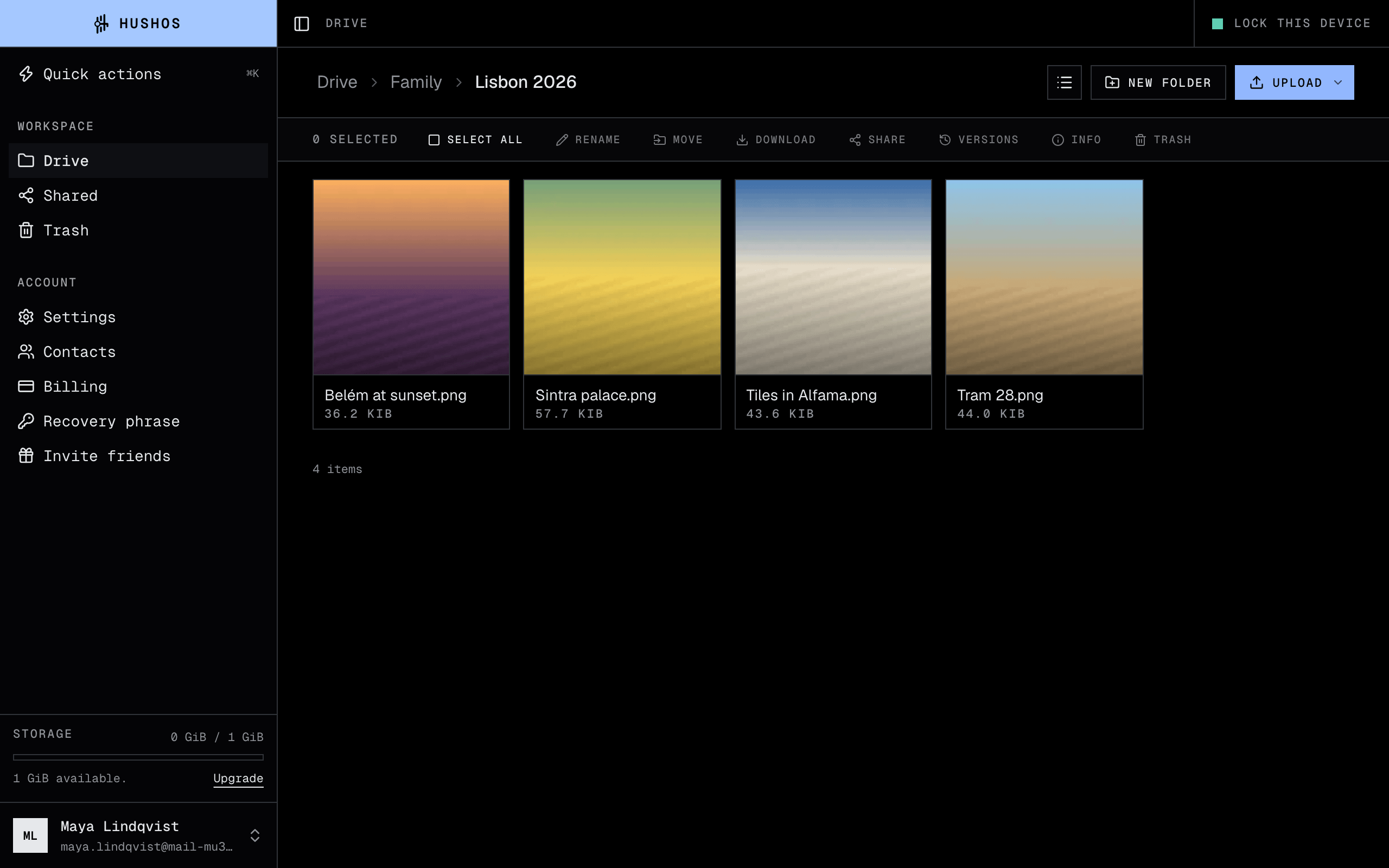
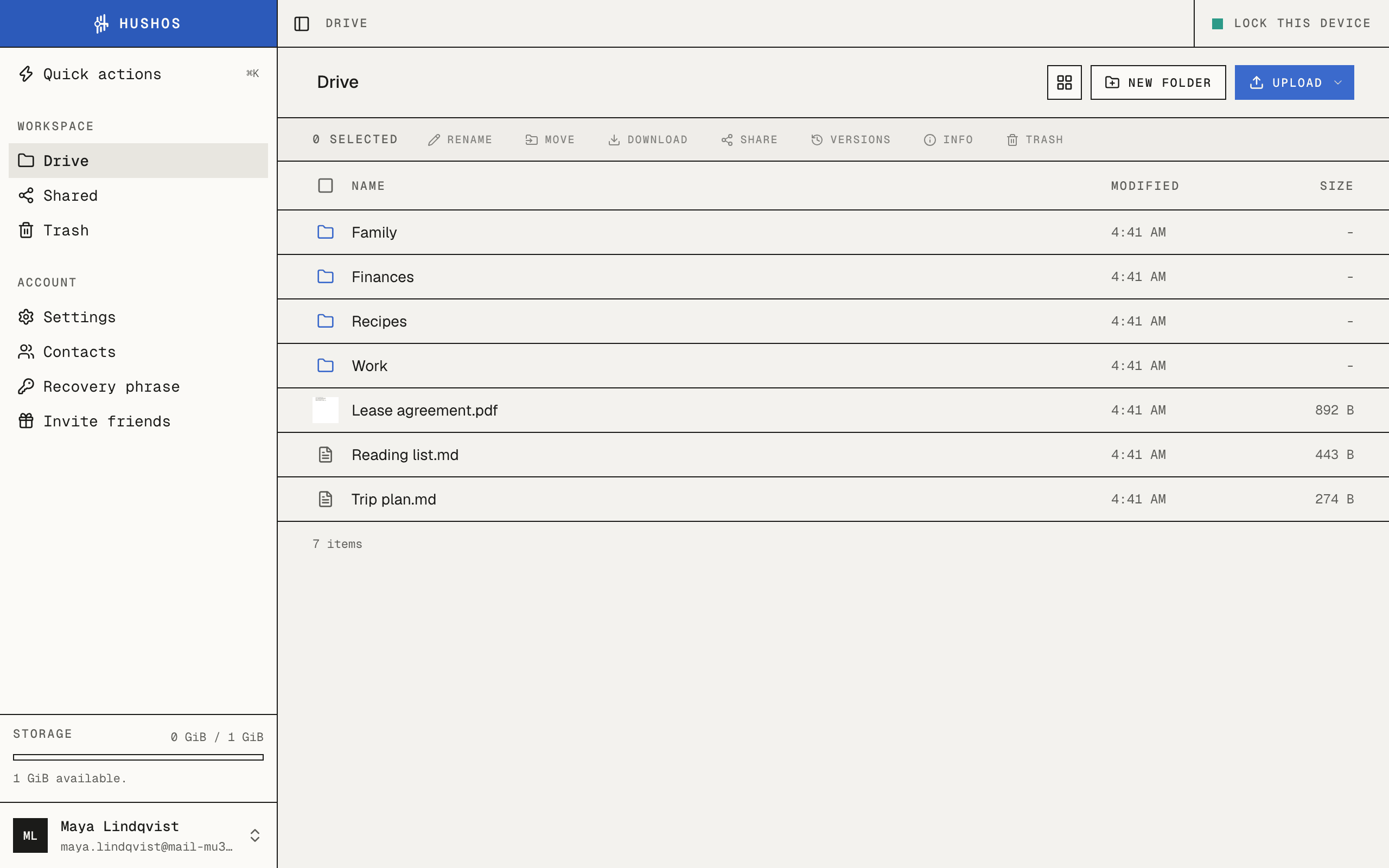
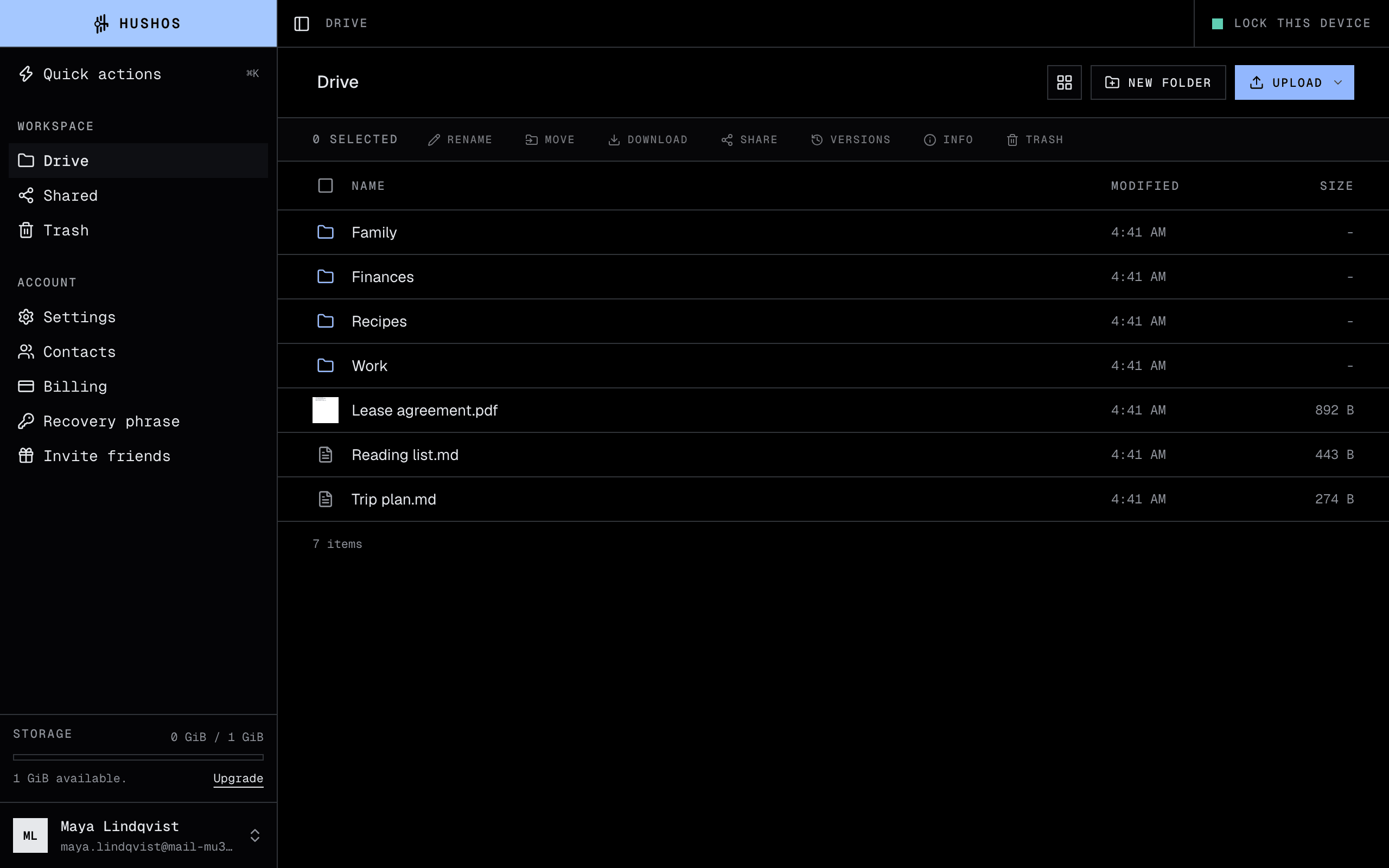
- Files and folders, with drag and drop, copies, sorting, and a grid view with thumbnails. Uploads resume if you close the tab; big files go up in pieces and finish where they left off.
- Previews for photos, PDFs, video and audio, Markdown, code, Word documents, spreadsheets and CSV files. Everything opens on your device; nothing is unlocked anywhere else.
- Sharing with people you know, as a viewer or an editor. They see it under "Shared with me" and can keep their own copy. The key is sealed to them with X25519 and ML-KEM-768 together, so what you share today stays private in a world with quantum computers.
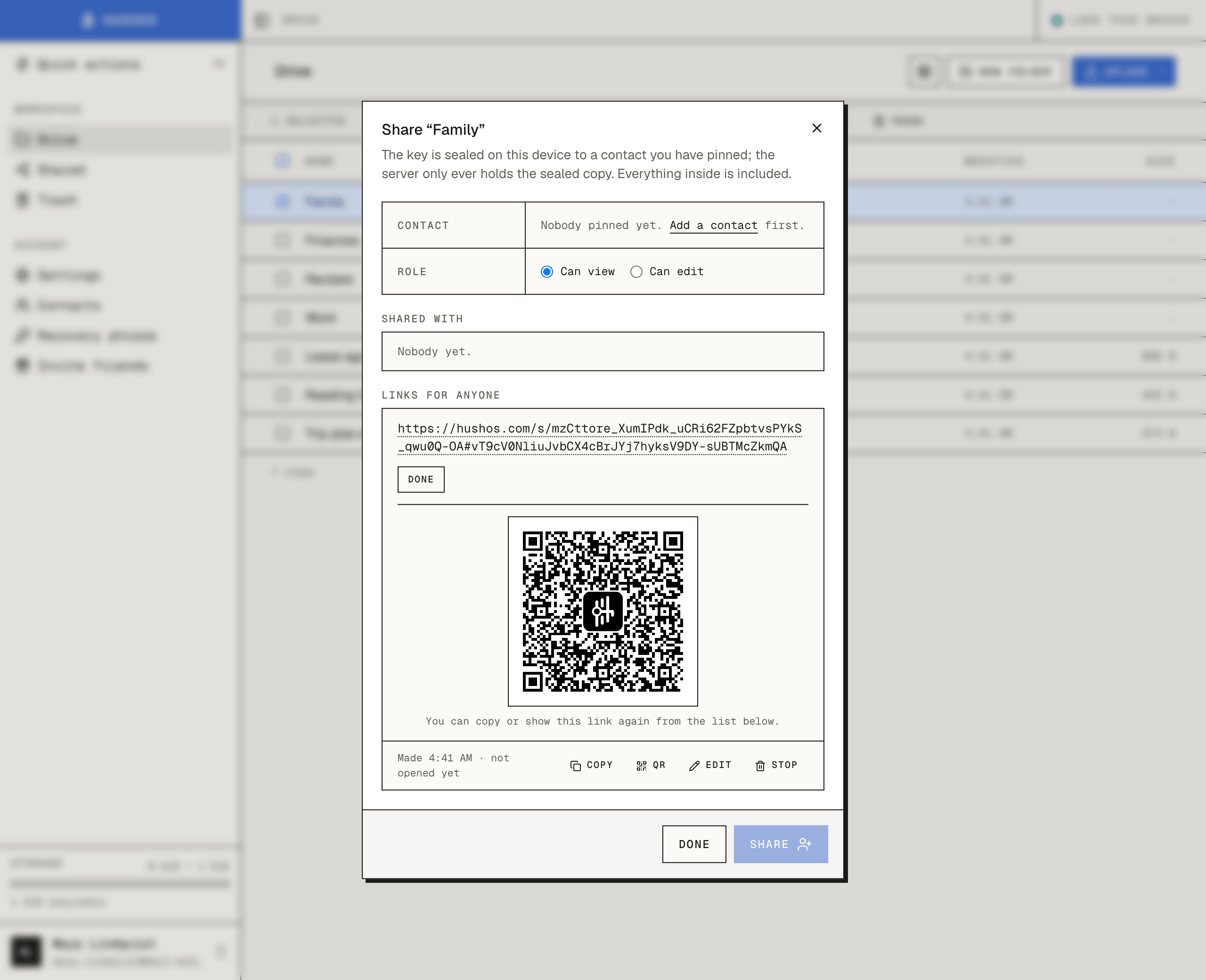
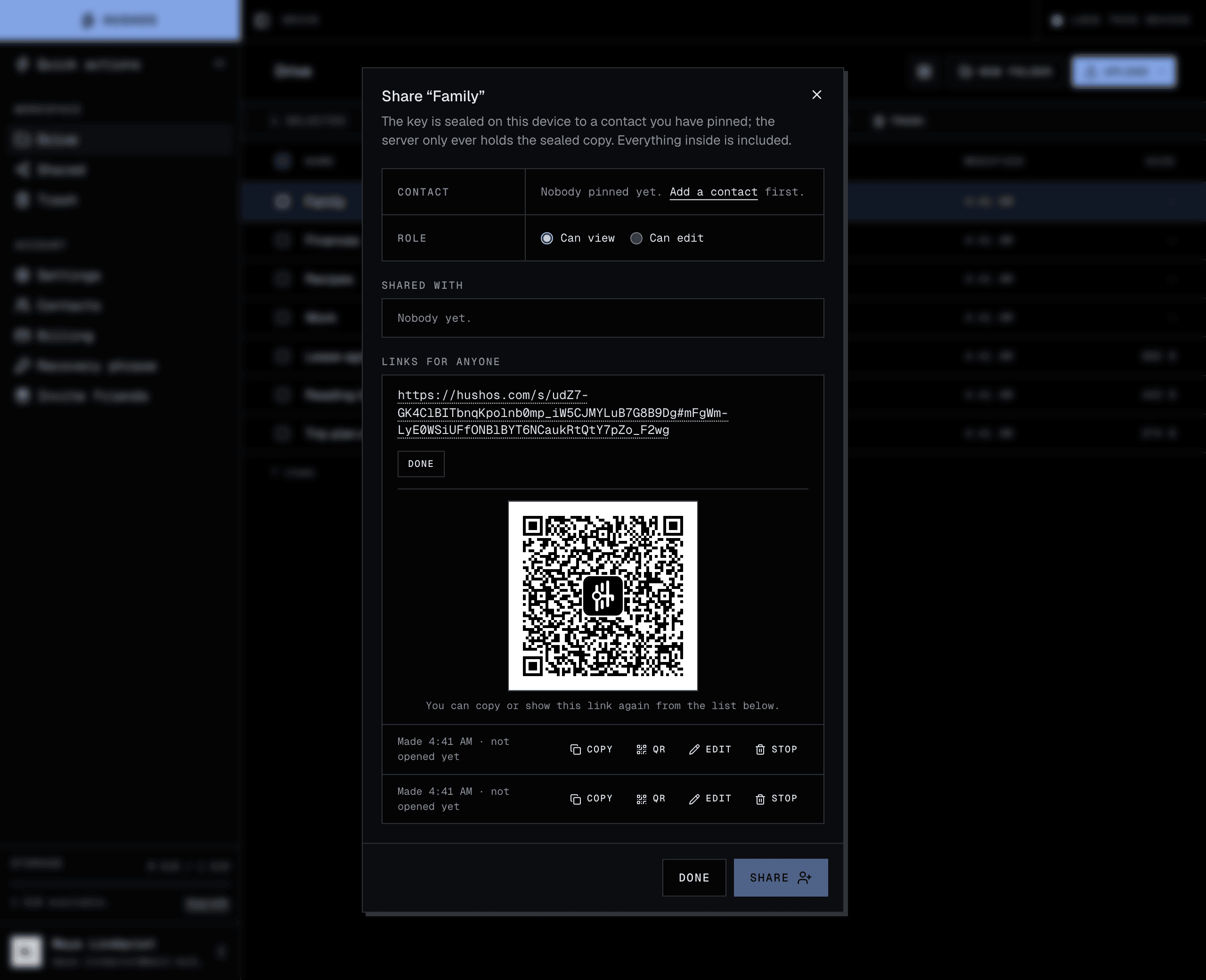
- Links for anyone, no account needed, with an optional password and expiry. Show it as a QR code if you like.
- Stopping a share that actually stops. When you cut someone off, the folder gets new keys. What they saw before stays shut.
- Versions and trash, so a mistake is not the end of anything.
- A phone app in the sense that matters: add it to your home screen and it behaves like one.
- Reporting, because privacy is not a shield for abuse. More on that below.
It runs two ways:
- At hushos.com. The free plan gives you two gigabytes, and every friend you invite earns you both more. Paid plans add space and nothing else.
- On your own server, for free. The guide walks you through it.
Same code, either way.
What we got wrong the first time
HushOS is not our first attempt at this.
Before it, we built a prototype: an encrypted drive that worked. Files were encrypted in the browser. Every folder and file had its own key, wrapped under its parent's. Encrypted bytes went straight to object storage without touching the application server. Those ideas were right, and they are still the shape of HushOS today.
But a prototype that grows keeps its shortcuts. Before writing a line of the real thing, we reviewed every line of the prototype and wrote down what it got wrong:
- The root folder's key was the account key itself.
- Envelopes were not bound to their position, so one could be swapped for another.
- Moves could create cycles.
- Quota was checked and then written, so two uploads at once could overshoot.
- Cancelling an upload updated a row and left the pieces in the bucket.
- Sharing was a checkbox that did nothing.
So we started over, with a design document instead of a prototype. Every item on that list became a rule and a test before it became code:
- Sign-in moved to OPAQUE, so the password never leaves your browser.
- Every key envelope names exactly where it belongs, so it cannot be moved.
- The tree cannot be bent into a loop.
- Storage is reserved before an upload begins and confirmed by the store when it ends.
- Sharing seals keys to people instead of flipping a flag, and stopping it rotates the keys beneath.
That list is why 1.0 is whole rather than merely finished. Every piece landed with its own tests, and the browser suite runs the whole product, on a phone-sized screen too, before anything is deployed.
Fighting bad actors
Anything that lets people share files privately will be tried by people with bad intentions. We built for that from the first day.
Private storage cannot reach anyone. Some material is harmful the moment it exists; the harm was done to a real person by whoever made it, and no storage design undoes that. What a service can stop is the spread, and spreading needs an audience. On HushOS an audience means a share or a link, and that is where every tool below applies.
Anyone with access can report. Every link page and every shared folder has a report button. When you report something, your browser seals the key for that item to the people who run the service. They can look at exactly what you reported and nothing else. This is the only way an operator ever sees content, and it is opened by a person who had legitimate access, never by us on our own.
Reports are acted on. A report takes a snapshot of what was shared and holds the bytes, so deleting the evidence does not make it disappear. Operators can:
- remove the content and stop every share and link to it;
- suspend the account that uploaded it;
- for material the law requires us to report, file it with the relevant authority, with the hashes and the evidence packet the law asks for.
The evidence cannot be tampered with. Copies of reported material go to a separate, write-once store that the application itself cannot delete from.
We do not become a surveillance service to do this. We do not log the network addresses of people who upload, share, or report. We do not scan your files, because we cannot. What we can do is act quickly and completely when someone who had access tells us something is wrong. That is enough to keep the place clean without watching everyone in it.
What comes next
Drive is the first room in a bigger house. The same keys, the same care, and the same refusal to make you do homework are coming to the rest of what people do every day:
- Desktop and mobile apps, coming very soon, so HushOS lives in your file manager and on your phone the way you expect, with the same protection.
- Messages, private the way your files are private, with the people already in your contacts.
- Notes and documents, written and kept under the same keys.
- The rest of a productivity suite, one piece at a time, each arriving whole and documented the way Drive did.
The code is on GitHub, and this blog is where each piece will be announced.
Questions people ask
Thank you for reading this far.